In a world that is quick to judge, people are too often labeled in absolute terms: they’re either good or they’re bad. This is especially true for those who are involved with the criminal justice system, have served time, or are at risk of doing so.
At Pioneer, we see things differently. We believe this one-size-fits-all approach fails to recognize the complexity of the human experience. Our services take into account the multiple facets that make up every person we serve with the goal of helping them discover their inner gem.
Our model is strategic, targeted and holistic, specifically designed to address the full spectrum of rehabilitation. Using assessment science and other data-driven approaches, we develop treatment plans that address basic needs like housing, healthcare, counseling and job training while also addressing underlying trauma and providing hope. The journey isn’t always easy, but for those willing to put in the work, we’ve proven time and time again that our approach can lead to a brighter and more stable future.
In addition to direct service, some of our most impactful work is in the advocacy arena, where we work to promote public policy that supports successful reentry. We also are increasingly working to build programs that keep people out of the criminal justice system in the first place. Together with our partners, we work with communities to design innovative programming that meets their evolving needs – by addressing addiction, homelessness and other issues that can lead to incarceration.
As long as society is more focused on punishing people than it is on preparing them to succeed in our communities, we’ll be here, inspiring confidence and hope in the people we serve. Because we believe in the dignity and potential of every single person, in every community, and we know that giving up on them simply isn’t an option.
secured employment
had no new arrests
average starting wage
business hired graduates
graduation from workshops
completed job-readiness workshops
361Family & social support services
352Health & wellness services
296Employment & education services
271Financial services
Like many communities across the state, Snohomish County has seen a spike in homelessness and people struggling with behavioral health disorders in recent years. They had invested in embedded social workers to partner with law enforcement to engage people into services. But too often, there was nowhere for people to go to get the support they needed. People who wanted treatment were not able to get into a program right away or ended up involved in the criminal justice system rather than treatment, and too many were unable to secure housing.
Working in close partnership with Snohomish County, the Snohomish County Sherriff’s Office and community partners, we designed two new programs to specifically address the community’s most urgent needs.
The Snohomish County Diversion Center is a 44-bed facility that provides residents a thorough needs assessment, assertive engagement into available services, medication assisted treatment options, and individualized support and recovery plan development.
The Carnegie Resource Center serves as a gateway to a multitude of resources including mental health counseling, substance use disorder treatment, employment services, housing enrollment, veteran programs, health insurance navigation and public benefit enrollment.
In their first full year of operation, these new programs are delivering!
Recidivism decreased
Treatment increased
Housing increased
1,935 served
233 got deposit assistance to secure housing
165 received benefits to access primary care
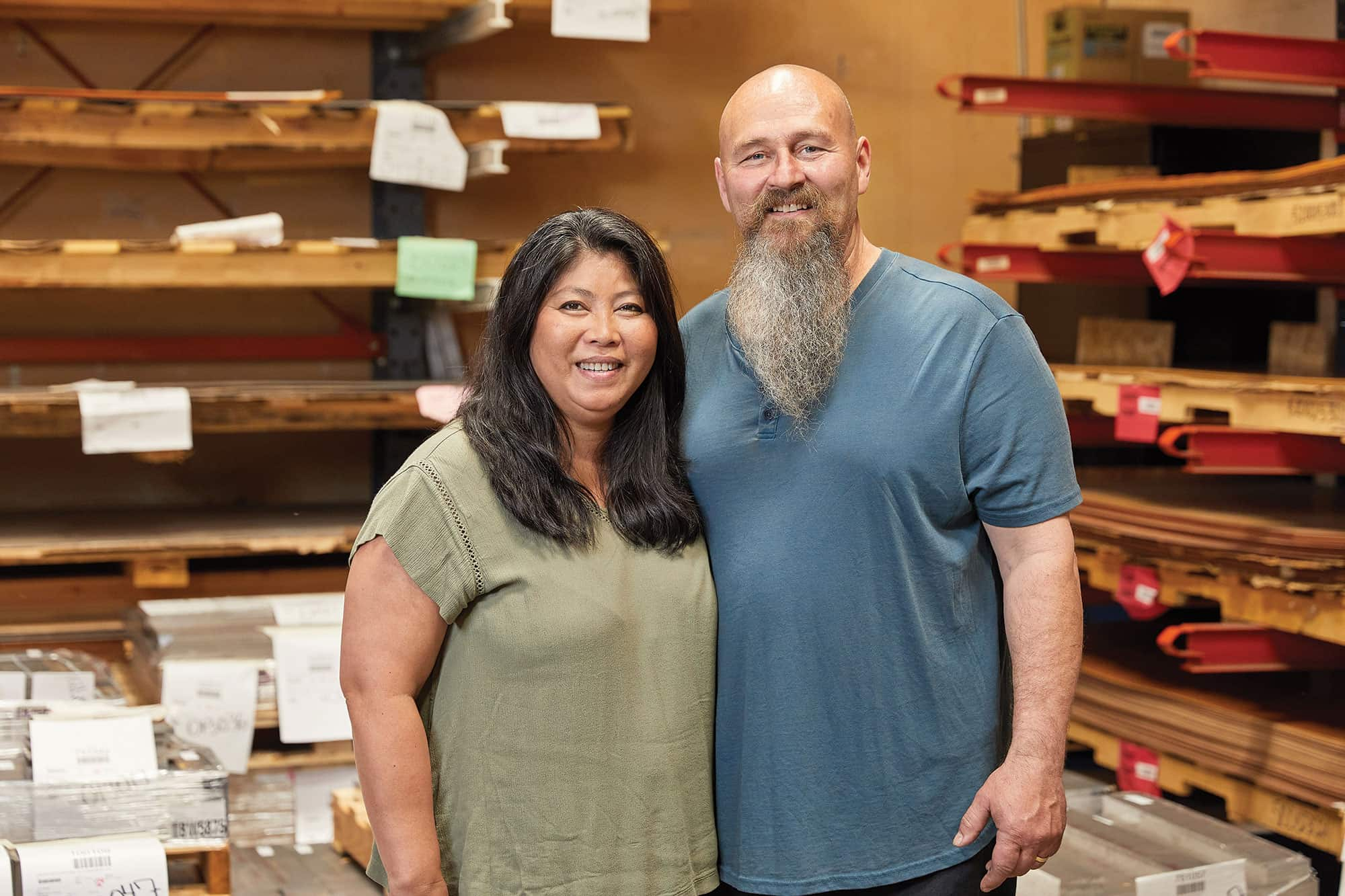
Pioneer has been such an important part of our story. We first met when we were transitioning back into the community from federal prison at Pioneer Fellowship House. I was devastated and full of shame, but the people who worked at the reentry center helped me overcome that – they helped me see my worth again.
Michael had even more to overcome. He had spent 22 years in prison so the whole world had changed while he was inside. Pioneer staff helped him navigate so many things – getting an ID card, his social security card, a cell phone. After looking for a job and facing rejection over and over because of his record, they referred him to Pioneer Industries for an inventory job.
We both got apartments through Pioneer when we left the reentry center. That allowed us to save up, get a bigger place together and have my son move home with us.
“I was devastated and full of shame, but the people who worked at the reentry center helped me overcome that – they helped me see my worth again.”
Currently, we both work at Pioneer Industries. It’s allowed me to put my office skills to use and I love greeting everyone as they come into the building. Michael has been promoted several times – he’s always the first to volunteer to take on a new project and learn something new – and we’re both so proud of all he has accomplished. We’re thankful to work in a place where we are valued for our skills and not judged for our past – and where we have the opportunity to learn and grow while providing a good life for our family.
Today we own our own home, we go on vacations, we have a beautiful garden, and Michael grows and cans food for the whole year. We built all of that together. Pioneer gave us the opportunity and the support to build lives that we love and are proud of!
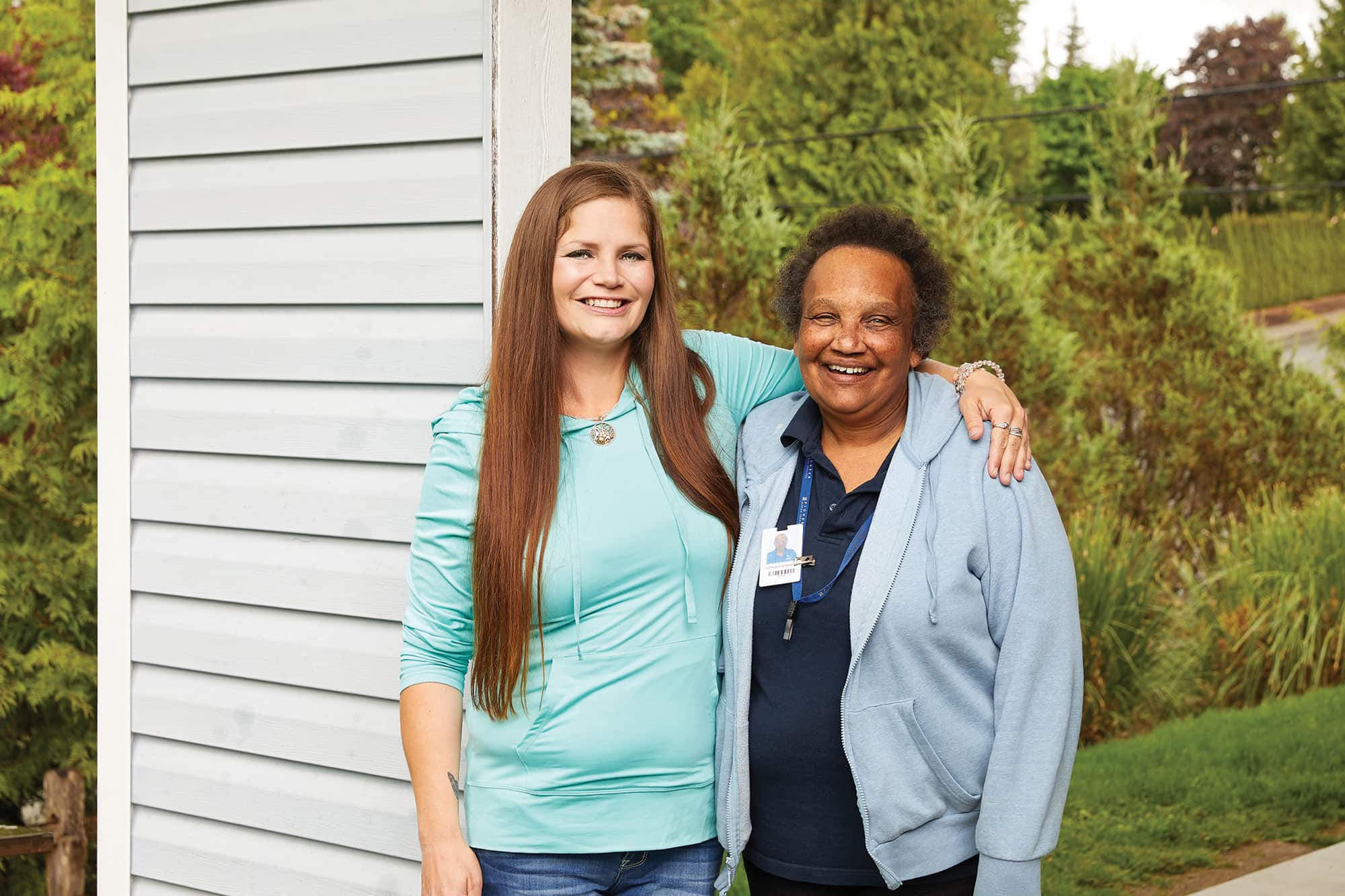
I wish I had known about Pioneer sooner. For many years, I struggled with my mental health and drug addiction, and my time in prison didn’t exactly rehabilitate me. I went through several other programs until I was fi nally referred to Pioneer Transition House. Kathie was my main support in the program—she’s a life saver. She believed in me from the start, and her endless compassion and ability to listen helped to build a bond of trust between us. When everyone else was saying, ‘Never’ Kathie constantly told me, ‘You can do this.’ And I did.
“When everyone else was saying, 'Never' Kathie constantly told me, 'You can do this.' And I did.”
Kathie went the extra mile to help me get in an outpatient treatment program that worked for me and get me off the medication prescribed that was doing more harm than good. When I was ready, she also brought together the people and agencies that helped me get my children back. Today, I’m feeling good, clean and sober, and have my children and family back in my life. I even have a full-time job as a restaurant manager to help provide for my family. I still reach out to Kathie as she is a constant support whenever I need to talk to someone. Pioneer was there for me to help me build back the life I wanted and they are still there—that’s comforting to know.
Our partners at the City of Spokane and Spokane County, and other community stakeholders have been working together for several years to decrease the jail population, reduce unnecessary ER visits, and provide safe, stable housing options in the downtown core.
To address these pressing community concerns, we converted the Carlyle from assisted living to serviceenriched housing for justice-involved individuals. Thanks to the support of the local legislative delegation, we secured capital funding to upgrade the facility to meet current housing codes in 2019. And with amazing ongoing support from community funders, we are able to provide on-site services and activities that are specifically designed to meet our residents’ needs and build a strong community within the facility.
This transition allows Carlyle residents to secure affordable housing and get the support they need to build healthy, productive lives in the community.
Housing stability increased
Well-being increased
Treatment success increased
Emergency service use decreased
Recidivism risk decreased
Pioneer is a two-fold nonprofit social enterprise. In addition to services, we operate multiple business lines that make a difference for the individuals and communities we serve. Our highly skilled workforce is integral to this equation. Earning a livable wage with many pathways to advancement, they are motivated to perform their best and do so with incredible pride. And we’re proud of them too. Their hard work and consistent performance help make everything we do possible.
“Justice-involved individuals are a hidden talent with so much to offer. They have helped us to build our aerospace manufacturing business into a successful and award winning enterprise. More employers need to consider this pool of talent.” — Karen Lee, CEO
69% of our enterprise workforce has a
conviction
history and/or is in recovery
manufacturing Pioneer Industries manufactured 1.6+ MILLION PARTS for the aerospace and commercial industries and continued to invest in cutting-edge equipment to expand our capabilities and better serve our customers’ growing needs.
distribution The distribution center managed, received, picked and shipped 300K AEROSPACE PART NUMBERS from 10 different manufacturers.
CONSTRUCTION Our construction team expanded into commercial tenant improvements and multi-family renovations, bringing on 6 NEW DEVELOPERS AND PROPERTY MANAGAGEMENT CUSTOMERS.
food We got our Washington State Department of Agriculture Food Processor’s License to expand commercial food production capabilities and we produced 1K+ PREPARED MEALS DAILY.
Dear Friends,
As we prepared our 2019 annual report, the world was confronted by COVID-19, one of the greatest health threats of a generation. The pandemic has changed the way we work and the way we provide services – and we are proud of how our employees and our partners have come together to meet the urgent and emergent needs of those we serve throughout this critical and uncertain time.
We are also in the midst of a significant social movement to confront racial injustice and cases of police brutality in this country. While we believe that many police are honorable in their approach to their very difficult jobs, the repeated deaths of unarmed black and brown citizens requires major criminal justice reform. Many of the people we serve have been directly impacted by these realities at every step in the criminal justice system from arrest to incarceration, and even through their reentry into the community. We are committed to centering racial equity in all of our work and to standing with other community leaders, impacted individuals and allies to help shape a more just society moving forward.
Looking back over 2019, this report highlights our concerted efforts to work with communities to address some of their most pressing concerns – with a focus on complex issues at the intersection of the criminal justice system, homelessness and untreated behavioral health needs. In recent years our advocacy efforts and service model have expanded to include diverting people away from incarceration toward more eff ective treatment options in addition to successful reentry.
As a leading organization in serving people involved in the legal system, we look forward to continuing to work with all of you to advance our mission and unite efforts in serving those in need. Our collective vision, leadership and willingness to serve will continue to create a positive impact in our communities if we work together. We live in times of great change, and Pioneer will not stand still.
Sincerely,
Randy Wilcox, Chair
Board of Directors
Karen Lee, CEO
Pioneer Human Services
Randy Wilcox, Chair
Retired - President for Americas Otis Elevator Company
Steve Mullin, Vice Chair
President, Washington Roundtable
Nancy Isserlis, Secretary
Attorney, Winston & Cashatt
Rob Bateman, Treasurer
Former CFO Emeritus Senior Living
Wade Black
SVP Commercial Banking Washington Trust Bank
Elizabeth (Betsy) Cadwallader
Market President, Puget Sound US Bank
Liz Dunbar
Retired-Former Executive Director Tacoma Community House
Jean-Francois Heitz
Retired-Deputy Chief Financial Officer Microsoft Corporation
Nicholas MacPhee
Chief Impact Officer, MiiR
Carlos Miller
Executive Director, GE Aviation
Christopher Poulos
Attorney & Executive Director Washington Statewide Reentry Council
Carlos Ruiz
Principal, Sidekick Consultants, LLC
Tonita Webb
Executive Vice President/COO, Seattle Credit Union
Karen Denise Wilson
Owner/Managing Attorney, KD Wilson Law PLLC
Ann Yoo
Philanthropist, Community Development Banking Executive
In 2007, the central conflict of Superbad was logistical: how to bridge the chasm between juvenile fantasy and adult reality. Seth’s desperate, misguided plan to buy liquor with a fake ID named “McLovin” is a metaphor for the adolescent condition—a frantic performance of maturity. The film’s humor derives from analog failure: the police cruiser, the shattered bottle, the embarrassing voicemail left on a crush’s home phone. “E hoje,” however, this landscape is almost unrecognizable. The “party” that Seth and Evan risk everything to attend has been largely replaced by the “hangout” or the private Snapchat story. The grand, terrifying gesture of buying alcohol for a girl is obsolete when social interaction is mediated through screens. Today, Seth would likely send a risky text; Evan would over-analyze an Instagram like. The epic, three-act struggle of Superbad has collapsed into the ambient anxiety of the group chat.
Ultimately, to watch Superbad “e hoje” is to feel a specific kind of nostalgia—not just for 2007 fashion or music, but for a texture of life. It is a nostalgia for the un-curated self, for the embarrassing voicemail, for the conversation that happens when you are too drunk and too scared to be cool. The film argues that growing up is not about achieving the goal; it is about surviving the journey alongside the people who see you at your worst. In a world that optimizes every interaction for efficiency and image, Superbad stands as a clumsy, heartfelt monument to the mess. It reminds us that the most terrifying thing for Seth and Evan was not the prospect of failure, but the prospect of facing the future alone. And today, surrounded by the noise of a billion virtual friends, that fear has never been more prescient. superbad - e hoje
Paradoxically, while the external quest has become easier (alcohol delivery apps, dating platforms, constant connectivity), the internal crisis Superbad diagnoses has become more severe. The film’s genius lies in its revelation that the goal—sex, popularity, the party—was never the point. The point was the conversation in the car, the fight on the staircase, the whispered confession, “I love you, man,” before falling asleep. This is the fragile intimacy that “e hoje” threatens to dissolve. In the age of curated perfection, the vulnerability Seth and Evan display—his admission of being a “pathetic excuse for a human being,” his friend’s fear of being left behind—is now often hidden behind layers of digital performance. We have achieved the superficial goal of constant connection, but we have lost the chaotic, beautiful, and often embarrassing friction of analog friendship. In 2007, the central conflict of Superbad was
Furthermore, Superbad serves as a critique of modern masculinity that feels even more urgent today. Seth and Evan’s obsession with sex is revealed to be a mask for their fear of emotional abandonment. Officer Slater and Officer Michaels, the absurdly childish cops, act as a funhouse mirror of the future: two men whose friendship has become their entire world, hiding in authority figures and reckless fun. “E hoje,” where discourse around toxic masculinity is louder than ever, Superbad offers a radical, if messy, antidote. It suggests that male bonding does not need to be performatively tough; it can be tearful, jealous, and deeply loving. The film’s final image is not of a sexual conquest, but of two boys bouncing on a trampoline at the mall, having failed at everything except the one thing that matters: staying present with each other. Today, Seth would likely send a risky text;
In the pantheon of teen comedies, few films capture the specific, sweaty-palmed terror of adolescence quite like Greg Mottola’s 2007 masterpiece, Superbad . On its surface, the film is a two-hour odyssey of crudeness: two awkward high school seniors, Seth and Evan, attempt to lose their virginity by supplying alcohol for a party. Yet beneath the raunchy jokes about phallic drawings and fake IDs lies a surprisingly tender eulogy for a specific kind of male friendship. When we view Superbad through the lens of “e hoje” (“and today”), the film transforms from a period piece of 2000s excess into a diagnostic tool for our current era of curated digital intimacy. The question is not just what Seth and Evan did to survive their youth, but what happens to their anxieties in a world that has traded the epic quest for a quiet swipe on a screen.